Disinformation and DID: the Politics of Memory
Brian Moss, MA, MFT
Disclaimer: The research and opinions in this well
documented essay are solely those of the author. All accusations are
alleged—based on available documents and nearly 30 years of experience
treating Dissociative Identity Disorder.
This essay is not meant to be comprehensive. Instead it is the
attempt to connect some dots that are rarely considered or discussed –
hopefully providing a new way to view the politics of memory and of DID
in particular. It is designed to generate discussion and suggest areas
of further study. There is an old saying: “Don’t bite my finger – look
where I am pointing.”
Ability to discern disinformation
Quality disinformation must contain a high degree of truth or it will
be rejected outright. The real value of disinformation is to present
pieces of the truth in a way that leads to the wrong conclusions.
A secondary purpose being obfuscation in general. There is an
overwhelming amount of disinformation on the internet and in our media.
Who would have guessed that when Orwell’s “Ministry of Truth” finally
arrived, we would embrace it as “Wikipedia.”
If I don’t know I don’t know – I think I know
If I don’t know I know – I think I don’t know1
Sometimes propaganda is nothing more than the big lie. Here is an
example as it relates to the environmental issue of fracking. (Hydraulic
fracturing is the process of drilling and injecting a mix of water and
toxic chemicals into the ground under high pressure in order to fracture
shale rocks and release natural gas.) This example involves watching
movies and reading an article exposing how public consensus is
manipulated. It is very informative, and an excellent and entertaining
example of the process known in public relations as the manufacturing of
consent:
1) First is the authentic documentary about the dangers of fracking – Gasland.2 And its short sequel – The Sky is Pink.3
2) This is followed by an industry sponsored “documentary” Truthland4where
the website, movie, and social media campaign were entirely
orchestrated by the natural gas industry while pretending to document
the concerns of Shelly dePue, “a Susquehanna County mom, dairy farmer
and teacher.”
3) Finally comes more authentic investigative journalism which, as is
so often the case, comes from a concerned individual filling in for a
mainstream media missing in action.5
It turns out that our narrator, “the Susquehanna County mom, dairy
farmer and teacher,” though busy reassuring other land owners, had
leaking fracking wells contaminating her own property. She traveled
around the state promoting corporate interests and misleading small
farmers and landowners.
The False Memory Syndrome Foundation (FMSF)
In March of 1992 the False Memory Syndrome Foundation was formed
claiming to have discovered a new syndrome. “Syndrome” is a clinical
term that requires certain agreed upon signs and symptoms indicative of a
disorder. The FMSF definition of “false memory” does not meet these
criteria:
Despite the
fact that “False Memory Syndrome” remained undefined and had never been
the subject of any research, the FMSF focused its early activities on
influencing the media and legal system…The definition of “False Memory
Syndrome” did not evolve from clinical studies; rather the purported
syndrome’s description is based on the accounts of parents claiming to
be falsely accused of child sexual abuse, usually by their adult
daughters.6
Many researchers and clinicians were concerned at this false aura of
authority given to an advocacy organization with a transparent agenda.7 As a response, seventeen researchers coauthored a statement in the American Psychological Society Observer
saying as much, declaring that the term “false memory syndrome” was “a
non-psychological term originated by a private foundation whose stated
purpose is to support accused parents.”8
But the foundation was a great deal more than that. Pamela Freyd, the
Executive Director and founder of the FMSF, functioned much as Shelly
dePue, the “Susquehanna County mom, dairy farmer and teacher” did in our
example above. Martin Orne, M.D., Ph.D., and Harold Lief, M.D., were
responsible for gathering the respectable appearing advisory board that
allowed the foundation to claim it was a scientific organization – and
they were the true force behind it.9 We know that Martin Orne had good reason to be – he was deeply involved with mind-control research10
at the University of Pennsylvania and many of the survivors coming
forward were remembering things that they were never supposed to
remember. Better that their memories were false.
One such survivor, Claudia Mullen, R.N., gave testimony to the Presidential Advisory Committee on Human Radiation Experiments on government sponsored mind control and ritual abuse:
Claudia S. Mullen, R.N., March 15, 1995:11
Twice I overheard conversations concerning a place or part of the agency called ORD12
[Office of Research and Development] run by Dr. L. Wilson Greene, Dr.
Stephen Aldrich, Dr. Martin Orne and Morse Allen. Once a crude remark
was made by Dr. Gottlieb about a possible leak over in New Orleans East,
involving a large group of retarded children who were being given
massive doses of radiation. [This aspect of Mullen’s testimony would be
corroborated 4 years later in Welsome’s book, The Plutonium Files: America’s Secret Medical Experiments in the Cold War.13]
He asked, why Wilson was “so worried about a few retarded kids? After
all, they would be the least likely kids to spill the beans!”
The second time I heard Dr. Martin Orne, who was the “Director of the Scientific Office” – later changed to Institute for Experimental Research
in order to keep more funding coming from different sources for the
radiation and mind control experiments. Dr. Orne suggested, “Stepping up
the amounts of all the stressors used on the subjects, such as
chemical, biologicals, increasing the volts and length of the electric
shock treatments, hypnosis14
and sexual humiliation” – the blackmail portion of the projects. He
stated, “It needed to be done faster, then get rid of the subjects, as
it was asking for “us” to come back and haunt them, by remembering.” Dr.
Heath at first refused but more of the doctors agreed; although some
seemed sincerely horrified at what they either witnessed or heard about.
Dr. Orne demanded that “Executive Action15
be taken. When one of my “splits”, as they referred to my dissociated
personalities, asked him (Dr. Orne) what “Executive Action meant?” he
replied, “It means we get rid of the little bitch – you! Don’t you get
it? You simply disappear, John (Dulles) can order that at any time; and
even Mac (John McCone) would never know what happened to you!”
A video of Claudia Mullen delivering her testimony is available online.16 17
The FMSF was a well organized disinformation campaign with ready access to media. As to the well established academic research18 on memory, and the majority of clinicians with real working knowledge of traumatic
memory – a veiling silence prevailed; these voices did not appear to
have the same access to media sources. The fierce debate regarding
traumatic memory was not taking place in therapists offices or even in
the scientific community generally; the debate did manage to enter a few
courtrooms but for the most part played out entirely in the media as
one would expect from a PR campaign.
A study
published last year [1996] by a University of Michigan sociologist,
Katherine Beckett, found a sharp shift in how four leading magazines – Time, Newsweek, U.S. News & World Report, and People
– treated sexual abuse. In 1991, more than 80 percent of the coverage
was weighted toward stories of survivors, with recovered memory taken
for granted and questionable therapy virtually ignored. By 1994, more
than 80 percent of the coverage focused on false accusations, often
involving supposedly false memory. Beckett credited the False Memory
Syndrome Foundation with a major role in the change.19
This is not to say that all members were aware of the deeper purpose;
many clinicians and researchers advocating for the FMSF agenda had no
experience working with DID, ritual abuse, or mind-control and no doubt
found the material too upsetting or difficult to believe. Throw in the
“alien-abduction” talking point [discussed later] and it became almost a
matter of professional self-respect to side with the Foundation on
issues of memory.
By far the largest category of membership in FMSF were families that had been accused of sexual abuse by their adult children.
The incest and sexual abuse of children in our society, though
hidden, is immense and beyond comprehension. These experiences are
quantified in what many trauma therapists consider to be the definitive
work on the subject:
If our
findings are indicative of the prevalence of child sexual abuse…it means
that approximately one in six women are incestuously abused before the
age of eighteen and one in approximately eight are so abused before the
age of fourteen. It means in addition that over one-quarter of the
population of female children have experienced sexual abuse before the
age of fourteen, and well over one-third have had such an experience by
the age of eighteen years. It is imperative that a problem of this
magnitude in the United States be addressed.20
Judith Herman, M.D., also addressed the prevalence of sexual abuse in our society. Her book: Trauma and Recovery: The aftermath of violence – from domestic abuse to political terror
was published within a month (April 1992) of the founding of the FMSF.
It is a classic in the field, much loved by therapists and survivors
alike – and one of the books most viciously attacked by the FMSF.
Understandably so, for Herman begins her introduction with, “The
ordinary response to atrocities is to banish them from consciousness…”
Not exactly in alignment with the talking points of the FMSF.
Chapter six refers to the legacy of child abuse as a public health issue :
The mental
health system is filled with survivors of prolonged, repeated childhood
trauma. This is true even though most people who have been abused in
childhood never come to psychiatric attention. To the extent that these
people recover, they do so on their own.21
While only a small minority of survivors, usually those with the most
severe abuse histories, eventually become psychiatric patients, many or
even most psychiatric patients are survivors of childhood abuse.22
The data on this point are beyond contention. On careful questioning,
50-60 percent of psychiatric inpatients and 40-60 percent of outpatients
report childhood histories of physical or sexual abuse or both.23 In one study of psychiatric emergency room patients, 70 percent had abuse histories.24 Thus abuse in childhood appears to be one of the main factors that lead a person to seek psychiatric treatment as an adult.25
Someone must be responsible for this level of sexual trauma
within society and yet I know of no efforts by the FMSF to hold anyone
accountable for this largely hidden epidemic of child sexual abuse – and
in contradiction to the statistics above, I do not remember a time when
the FMSF ever acknowledged that there is a significant problem to be
addressed. Here is an exchange from an early interview…26 with the figurehead of the foundation, Pamela Freyd:
Treating Abuse Today:
…But let me go back to something that I alluded to before, if I may. It
seems that the position of the FMSF is that we should be very careful
to determine the objective, forensic truth of allegations our patients
make, whether in or out of the forensic field. Yet, it also seems that
the Foundation is saying that it doesn’t need to do this with it’s own
membership. I was very alarmed and concerned about something you wrote
in one of the Foundation newsletters about the question of whether you
are representing pedophiles.
Freyd: That was one of the very first…
TAT: I’m sure you regret it. I want to remind you of
what you wrote in that article [“How Do We Know We are Not Representing
Pedophiles?”, February 29, 1992, FMS Foundation Newsletter.] This is an important question.
Freyd: It’s a tremendous question, and I would like to think that we’ve carried it further since then.
TAT: I would like to know how you’ve done that,
because what you said in your article was disturbing. You talked about
the issue in terms of its importance to your image and the ability of
the Foundation to get things done. There was less indication that it
would be a terrible fact if true.
Freyd: It would be horrible if that’s what we’re
doing. We have stated – I don’t know how many times – that there is no
way we can know the truth or the falsity of events to which we’re not a
party. I don’t know how therapists know that either.
TAT: But if that is true we must also accept the
premise that without outside corroboration, it is just as impossible to
prove that a memory is false. You are saying that there’s a false memory
epidemic across the country that is tearing families apart, but you
really don’t know for sure if the memories involved are, in fact, false.
The way you wrote about the possibility the Foundation is representing
pedophiles really disturbed me. You wrote, “The first way of addressing
this issue has to do with who we are. We are a good-looking bunch of
people, graying hair, well dressed, healthy, smiling; just about every
person who has attended is someone you would surely find interesting and
want to count as a friend.” That wouldn’t rule out Ted Bundy, Pamela.
That’s not scientific!
This demographic – aggrieved parents denying their children’s
allegations of abuse – became the voice of the foundation and it was
behind this demographic, that the likes of Martin Orne and, no doubt,
Ewen Cameron if he was still living, would take cover – even if it meant
overturning a century of clinical research as to how traumatic memory
worked.
Alfred McCoy, a professor of history at the University of Wisconsin –
Madison, documents the hidden history of psychology . Writing under the
chapter heading, “Science in Dachau’s Shadow:”
Psychology’s
service to U.S. national security has produced a variant of what the
psychiatrist Robert Lifton has called, in his study of Nazi doctors, a
“Faustian bargain.” In this case, the price paid has been the American
Psychological Association’s collective silence, ethical “numbing,” and,
over time, historical amnesia.27
Indeed, Lifton emphasizes that “the Nazis were not the only ones to
involve doctors in evil”; in defense of this argument, he cites the Cold
War “role of …American physicians and psychologists employed by the
Central Intelligence Agency…for unethical medical and psychological
experiments involving drugs and mind manipulation.”28
Lifton, who is often cited on the atrocities of the Nazi doctors,
should be very familiar with “Faustian bargains” – he was a cofounder of
the Human Ecology Fund, the CIA contractor that showered both Martin
Orne and Ewen Cameron (psychic-driving studies) with research grants in
the 1960s.29
Originally formed in 1955 as the Society for the Investigation of Human
Ecology, it changed its name in 1961 to the Human Ecology Fund and was a
CIA controlled funding mechanism for studies and experiments (often
illegal and unethical) in the behavioral sciences.30 Lifton was also a project leader for early mind-control research for the Air Force.31
This is the real back-story to the founding of the FMSF. Perhaps the
greatest hypocrisy was the stance the Foundation took regarding Multiple
Personality (MPD) – now known as Dissociative Identity Disorder (DID) –
that it does not exist. Yet many members of the founding advisory board
knew better because the goal (successfully achieved) of the covert
research was to do just that. There was truth in one of their talking
points though: that Multiple Personality is created by doctors. They
just never said which ones.
Two of the many lines of covert research involved psychic-driving and sensory deprivation:
Psychic-Driving
I have never worked with a mind-control survivor that was not
subjected to repeated psychic-driving. This procedure is based on two
concepts: the breaking down of personality, originally referred to as depatterning32, combined with the introduction of new ideas or beliefs – psychic driving.
Depatterning is an assault on the personality using any combination of
electric shocks; drug states; sensory deprivation; and sleep
deprivation. The stated purpose for the original research in this area
was for the purpose of interrogation but further investigation extended
the possibilities into the area of mind control and manipulation of
personality states. The goal is to overwhelm the personality for the
purpose of introducing new behavior, thoughts and feelings. After the
erosion of one’s sense of self, messages are repeated in a continuous
loop over long periods of time and can be further paired with pain or
pleasure to generate conditioned responses. When combined with
dissociated states new personalities with separate belief systems and
behavior can be established. Early on, psychic-driving consisted of
audio messages played in tape loops but quickly evolved to include
staged scenes using 3-dimensional objects, culminating in animatronic33
devices and virtual reality experiences. The perceived figures
delivering these messages may represent people from the child’s life,
alters within the child’s developing DID system or fictional characters.
This evolution of psychic-driving technique made the messages interpersonal
and not simply a voice in one’s head. The 3-dimensional objects – from
simple dolls and mannequins to sophisticated puppetry and animatronics –
allowed for the processes of projection and introjection to take place.
Let me clarify what I mean by the interpersonal nature of later
generation psychic-driving techniques: I had a friend that was serious
about practicing meditation. He traveled to Burma for several months to
study with a renowned teacher of Theravāda Buddhism. It was a rare
opportunity to study the mechanics of how our minds work and to gain the
wisdom that comes from experiencing ever more subtle levels of
consciousness. When he arrived in the community he was intimidated to
participate in the large meditation hall on his first day so instead he
found one of the smaller meditation huts, scattered around the
surrounding forest, to ease into his new environment. As he entered the
secluded shelter – there was the teacher he had come to study with
– sitting in meditation perfectly still at the front of the room. Just
the two of them. My friend quickly sat down at the back of the room, his
mind whirling with thoughts and emotions regarding this new
development. For the next hour and a half he was all over the place –
wanting to impress this teacher he had so much respect for; worried he
was breathing too loudly; knees hurting but not wanting to move lest he
be seen as a beginner; occasionally opening one eye to see the teacher
sitting blissfully still and profoundly at peace as his own agitation
and impatience increased. Finally he could not bear it any more and,
after giving it his best effort, he arose to leave. On his way out he
took a closer look – he had been sitting in front of a statue!
My friend was an adult with plenty of life experience practicing awareness in a safe community, not a frightened child, uncertain of where they were, and likely drugged or in a hypnotic state.
The first book length treatment of psychic-driving as a mind control technique was In the Sleep Room published in 1988.
In August
1977 Canadians reacted with horror and revulsion when they learned that
in the 1950’s and early 1960’s, one of the most eminent psychiatrists in
the country had used his vulnerable patients as unwitting guinea pigs
in brainwashing experiments funded by the CIA and the Canadian
government…Dr. Ewen Cameron, the director of Montreal’s Allan Memorial
Institute34, exposed dozens of his own patients to barbaric treatments from which some never fully recovered.
Cameron was not alone in his desire to reprogram the human brain. The
U.S. intelligence establishment found in him an eager collaborator, and
funded his work substantially and covertly. Eventually, after years of
stonewalling by the CIA, nine of the dozens of victims were at last
given a chance to claim restitution for Cameron’s “treatments” by taking
the powerful U.S. intelligence agency to court.35
A second book documenting this early research – and the subsequent legal case against U.S intelligence agencies36 – was written by the son of one of the survivors, himself a psychiatrist.37
Especially disturbing was the deeply unethical and illegal activities
carried out by prominent medical authorities, including Cameron, who
despite being present at the Nuremburg trials went on to engage in
research that violated every aspect of the ensuing Nuremburg code.
Cameron had already conceived of the technique he called
“psychic-driving” by 1953 and claimed to be able to make “direct,
controlled, changes in personality” when covert funding arrived to take
the research even further.38
At the time, he was President of virtually every professional
organization in his field including the Canadian, American and World
Psychiatric Associations as well as the American Psychopathological
Association and the Society of Biological Psychiatry. The excesses that
came to light in Montreal were not isolated incidents, simply a rare
situation where covert research came to light. In fact, during the legal
proceedings that unearthed much of what we officially know about this
particular project and period of time, the court ruled that the CIA did
not have to disclose the names of the other 185 private researchers that came to light through discovery.39
Within just a
few years, this allied scientific offensive would pursue classified
research concealed inside public and private facilities of five major
nations – including a British “intelligence research unit” at
Maresfield, Sussex; an Anglo-American facility near Frankfurt for lethal
experiments on captured Soviet-bloc “expendables”; CIA-funded
psychology research at leading U.S. hospitals and universities; periodic
allied conferences to exchange results; and, above all classified
Canadian studies of sensory deprivation at McGill University.40
And of course, these were only the researchers that left a paper
trail – usually due to records of government funding – a mistake that
would not be repeated in the future.
Sensory deprivation
Donald Hebb was a highly respected cognitive psychologist famous for
Hebb’s Law stating: “neurons that fire together wire together”; a deeper
truth is that he could also be considered one of the developers of
psychological torture.41
He was Cameron’s colleague and head of the Psychology Department at
McGill University. He also received covert funding from the U.S.
intelligence community42 and the earliest public records of research in sensory deprivation are from Hebb and his students.43 A good summary of covert research at McGill can be found in Torture and Impunity: the U.S. Doctrine of Coercive Interrogation by Alfred McCoy44.
He takes a scholarly approach, working with publicly available
documents, which narrowly frame his research in terms of an acceptable
narrative: interrogation techniques.
There is a much deeper story however: this research was far more
wide-ranging and, though compartmentalized even for many of the
researchers themselves, was being utilized for mind control and
ultimately the creation of DID by others. What came to light was just
the faintest indication of what was really going on. There is one memo,
dated January 25, 1952 where the CIA declares its intentions: “the
evaluation and development of any method by which we can get information
from a person against his will and without his knowledge,” and
eventually, “control of an individual where he will do our bidding
against his will and even against such fundamental laws of nature as
self-preservation.”45
Any investigative journalism that attempts to follow this trail will
fail – and understandably so – the darker realities of this stated goal
have no official documentation; the torture of children is a difficult
sell, even under the guise of “national security.” There will be no
authorized disclosures or official documentation regarding this level of
research – only the narratives being pieced together in therapists’
offices by those who endured the legacy of this research – and there are
many.
Sensory deprivation has a devastating psychological impact and can
lead to the complete dissolution of the personality accompanied by
hallucinations, delusional thinking and general incoherence. It is
presently acknowledged as a form of torture; in fact, it is one of a
group of “enhanced techniques” that are entirely psychological in nature
and unique in that they do not conform to the general public
understanding of what torture is.
Covert research on DID
The fact that Intelligence and Military sponsored doctors and
researchers had intentionally created and used multiple personalities46 – this was the story that had to remain veiled and silenced and these disinformation efforts go well beyond the FMSF.47 48
The idea
that there could be a deliberate disinformation campaign element to the
False Memory movement is perfectly plausible, consistent with history,
and could be expected. There is bound to be some sort of disinformation
strategy if, in fact, Manchurian Candidates have been leaking out into
civilian psychotherapy. So here we have, with all of this documentation,
all of this proof – we know that it is perfectly possible that people
we are seeing in therapy who are claiming to be victims of systematic
military mind-control experimentation are telling us about what actually
happened to them.49
From research to implementation
And that is exactly what is happening; survivors from around the
world are coming forward and describing what happened to them. Some
write memoirs with such skill that their voice establishes an emerging
literature of these previously unknown histories.50
Others express their experiences through their art.51
The thought-bubble in the illustration below shows a ritual abuse
trauma scene being recalled for aversive programming. This is taking
place in a clinical setting where many other features of mind control
programming are on display. The illustration represents a relatively
simple programming site, both in terms of the era (1968) and the
location (a Detroit pediatrician’s office). More comprehensive
procedures would have been performed in other, more elaborate settings.
Present day programming venues benefit from decades of additional
research, improved technology and the latest pharmaceuticals.

(Illustration by Lynn Schirmer)
History Of Trauma Treatment
The type of treatment generally accepted by trauma experts, one which
divides the overall trauma treatment into discrete phases or stages,
each with its own treatment objectives and goals, is known as phase-oriented treatment.52
Phase-oriented trauma treatment, the idea of separate memory systems,
and the realization that traumatic memory is different from ordinary
memory, was first presented by Janet at the turn of the century.53 Janet followed Charcot as the head of Psychology at the Salpêtrière in Paris, the birthplace of modern dynamic psychiatry.54 Janet’s contribution is important because he was among the first to recognize dissociation as a cognitive disturbance, something he referred to as the narrowing of the field of consciousness, a concept Freud would later borrow and call repression.55 Out of this recognition grew the first information-processing model of trauma treatment, one that anticipated current treatment standards by a century.56
Janet’s investigation into hysteria (dissociation) as a psychological process paralleled the work of Breuer57 and Freud58 in Vienna, Myers59 in London and Prince60 in Boston.
Understanding the true etiology of DID
Complex DID systems are not simply a response to trauma – even
horrific trauma such as ritual abuse, though it does have a role to
play. Nor is it caused iatrogenically by well-meaning therapists
attempting to treat trauma survivors as Wikipedia would have us believe.
DID is mind control, intentionally practiced and requiring a
great deal of effort and conditioning over a period of many years. To
develop an elaborate DID system is to endure an ongoing medical procedure throughout childhood, one that requires clinical settings with access to extensive equipment and pharmaceuticals.
At the turn of the century there were indeed cases of “split
personality,” a phenomena observed by many of the pioneers attempting to
make sense of dissociative processes: Pierre Janet in Paris; Breuer and
Freud in Vienna; F.W.H. Myers in London; and Morton Prince in Boston.
These initial reports were found to be the result of trauma in childhood
but rarely produced more than a few alter states and often just one.
Childhood incest does not lead to elaborate DID systems.
Modern DID bears no resemblance to these early, primitive cases
but is instead the outcome of a century of covert research on these
dissociative states and their successful creation and exploitation.
The exploitation can occur in many contexts, with the common feature
being that any activity remains hidden and compartmentalized. Typical
contexts of abuse, many of which overlap61, include: cults62 and deviant social networks; child pornography/prostitution; medical/psychological research63, military or intelligence networks64; private contractors;65 organized crime (banking, drugs66/weapons, human trafficking).
Of late there is an increasing privatization of what have
traditionally been military and governmental services. These groups are
without oversight and completely unaccountable to any democratic
structures – covert activities are more easily compartmentalized and
denied. Mind control, medical experimentation, and military/intelligence
training with predominantly fascist ideologies all flourish in these
contexts.67 68With
DID – of obvious value is the ability to exert hidden control
throughout society by placing people in key political, law enforcement,
legal/judicial, and media positions.69 One example will suffice: a description of the alter named Ragen from the book The Minds of Billy Milligan70 published in 1981:
Ragen, age
23, is the ‘keeper of hate.’ His name is derived from “rage-again.” He
identifies as Yugoslavian and speaks English with a noticeable Slavic
accent. He also reads, writes, and speaks Serbo-Croatian. A
weapons and munitions authority as well as a martial arts expert, he
displays extraordinary strength stemming from his ability to control his
adrenaline flow. [Another alter named Arthur reads and writes fluent
Arabic.]
Not exactly the skill-sets one would expect as a random response to
childhood trauma are they? And you would have to wonder what kind of an
agenda a therapist would bring to create Ragen iatrogenically. Billy
Milligan’s DID was a structured, clinically created system designed to
produce a covert soldier. He was also trained to function in the Middle
East, hence the fluent Arabic.
The false comfort of “national security”71
Some will claim that efforts to create DID in children were excesses
of the Cold War, motivated by an urgency where the ends justified the
means; and that the efforts were not successful. This is not the case.
It is ongoing, and mind-control has spread far beyond the contexts of
early research and is now fully operational in several generations of
survivors.
Government, Military and Intelligence communities are vast labyrinths
of agencies and personnel operating with various degrees of
compartmentalization very similar to DID itself. Many honest, decent,
ethical, hardworking people take part in these communities. Many others
have lost their way. When corrupt factions within any of these
organizations remain hidden and protected by claims of “national
security” our democratic structures are undermined and eventually break
down.
Clearly, people that would torture children to create DID, for any
agenda, are sociopathic and merely hiding behind claims of “national
security.” What they are really after is a type of power that is outside
legal or ethical constraints and better described as organized crime.
[A side note regarding language: The phrase “organized crime” does not
raise eyebrows or end conversations. The phrase “conspiracy theory” does
– yet “organized crime” and “conspiracy” are essentially equivalent in
meaning.”] The whole idea of “national security” must be considered in
light of the fact that high level German diplomatic, intelligence and
military personnel were folded into the U.S. intelligence and military
communities in the aftermath of the war. And it is not simply imported
Nazis that tarnished our shining democracy. Few understand how many in
the U.S. had always been sympathetic to the Nazis and their cause.72
Nazi research continues in the U.S.73
General Reinhard Gehlen,
the most senior German intelligence officer on the Eastern
front…derived much of his information from his role in one of the most
terrible atrocities of the war: the torture, interrogation, and murder
by starvation of some 4 million Soviet prisoners of war…the success of
this interrogation program from the German military’s point of view
became, in fact, the cornerstone of Gehlen’s career. It won him his
reputation as an intelligence officer and his Major General’s rank.
But these same interrogations were actually a step in the liquidation
of tens of thousands of POWs. Prisoners who refused to cooperate were
often tortured or summarily shot. Many were executed even after they had
given information, while others were simply left to starve to death.
True, Gehlen’s men did not personally administer the starvation camps,
nor are they known to have served in the execution squads. Such tasks
were left to the SS, whose efficiency in such matters is well known.
Instead, Gehlen’s men were in a sense like scientists who skimmed off
the information and documents that rose to the surface of these
pestilent camps. Now and again they selected an interesting specimen: a
captured Russian General ready to collaborate, perhaps, or a Ukrainian
railroad expert who might supply the locations of vulnerable bridges
when given some encouragement to talk. Gehlen’s officers were
scientists in somewhat the same way that concentration doctors were:
Both groups extracted their data from the destruction of human beings.74
Yet Gehlen did not suffer the same fate as his victims after the War –
most people are stunned to discover that he was working for the U.S.
within months of surrendering to American Counterintelligence in May of
1945. Of even greater concern – he brought his entire network of
collaborators and Nazi military and intelligence contacts with him.
Intelligence networks were just one of the groups exploited after the
war. Nazi doctors, chemical warfare specialists, weapons systems
developers – scientists in every imaginable field – mind control
research included, all found protection and work. Also protected were
the powerful bankers and industrialists with their global cartels that
could be said to have financed the Nazis’ rise to power in the first
place and posed the greatest threat to a resurgence of Fascism later.75
Surely these “assets” contributed more than their skills and knowledge.
They brought their political philosophy with them as well, and that
political philosophy was Fascism.

Nazi
scientists working on U.S. weapons development (Space Program); brought
to the U.S. under Project Paperclip at White Sands Proving Ground, New
Mexico, in 1946. Twenty two were still living in 1985 when another group
photo was taken, standing in front of a Saturn V rocket, at the Alabama
Space and Rocket Museum in Huntsville, Alabama.
NASA and the aerospace industry were home to many Nazi scientists:
The most famous is Wernher von Braun. He was a
member of the Nazi party and an Nazi SS officer responsible for the
design and building of the V-2 Rocket at Mittelwerk and Peenemünde.
During the war, Peenemünde became the birthplace of modern rocketry with
the development of the V-2 Rocket. After the site was bombed by the
Allies a new research center was built near Blizna, Poland using 2000
prisoners from the Pustkow concentration camp. They were killed after
completing the project.76
Part of bringing him to the U.S. involved expunging his Nazi activities
during the war and minimizing his involvement (He had joined the SS at
the personal behest of SS chief Heinrich Himmler.) He denied being aware
of the forced labor using prisoners (20,000 worked to death from
Mittelbau-Dora) but evidence suggests otherwise.77
He was to become the first director of the Marshall Space Flight Center
in Huntsville, Alabama and instrumental in popularizing space flight
and nuclear energy, the dark sides of which are, of course, the
development of weapons systems:
Less than ten years after the liberation of Dora-Nordhausen, von Braun was giving orders to Disney animators and designing a ride at Disneyland called “Rocket to the Moon.” Heinz Haber, another key Tomorrowland
adviser and eventually the chief scientific consultant to Walt Disney
Productions – spent much of World War II conducting research on
high-speed, high-altitude flight for the Luftwaffe Institute for
Aviation Medicine. In order to assess the risks faced by German air
force pilots, the institute performed experiments on hundreds of inmates
at the Dachau concentration camp near Munich. The inmates who survived
these experiments were usually killed and then dissected. Haber left
Germany after the war and shared his knowledge of aviation medicine with
the U.S. Army Air Force. He later cohosted Disney’s “Man in Space”78
with von Braun. When the Eisenhower administration asked Walt Disney to
produce a show championing the civilian use of nuclear power, Heinz
Haber was given the assignment. He hosted the Disney broadcast called
“Our Friend the Atom”79 and wrote a popular children’s book with the same title, both of which made nuclear fission seem fun, instead of terrifying.80
“Our Friend the Atom” was sponsored by General Dynamics, a manufacturer
of nuclear reactors. The company also financed the atomic submarine
ride at Disneyland’s Tomorrowland.81
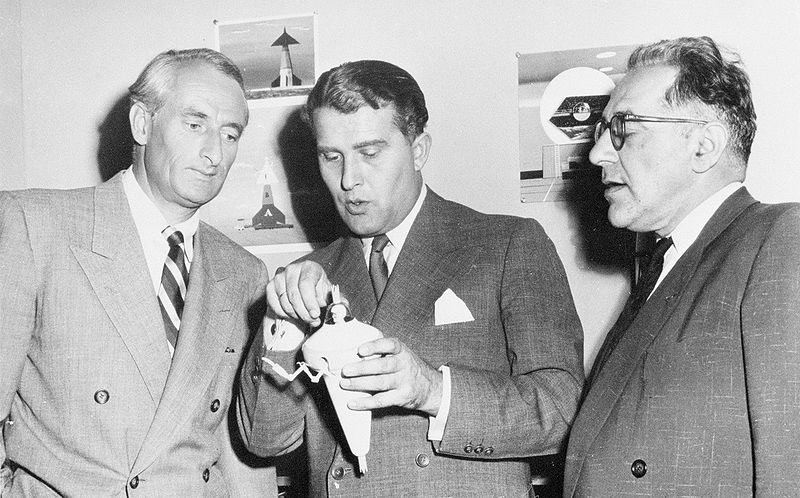
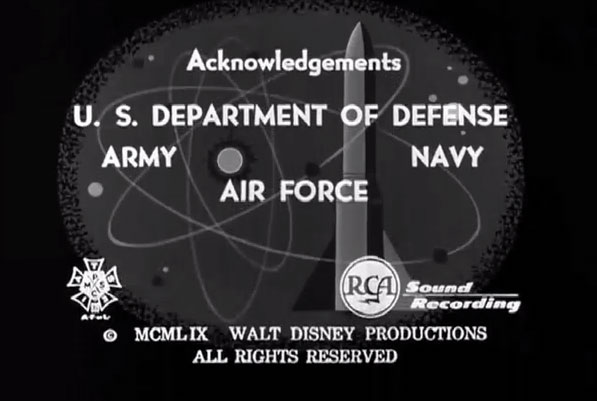
The Scientific Advisors for the Disney film Man in Space
from left to right: Dr. Heinz Haber, Dr Wernher Von Braun, and Willy
Ley. The acknowledgements in the screen capture hint at the real
emphasis of the space program which was sold to the public via NASA, a
civilian space agency.
Major General Walter Dornberger was the wartime
commander at the Peenemünde missile site. He oversaw the forced labor
from the Nordhausen concentration camp where 20,000 prisoners were
worked to death. After the war he came to the U.S., eventually becoming
Vice President of Bell Aerosystems.
Arthur Rudolph received NASA’s Distinguished Service
Award in 1969 for his role as project director for the Saturn V moon
rocket. He was well qualified. “[He was] chief operations director of
the Mittelwerk rocket factory. Not only had he set the schedules by
which prisoners were worked to death; but, it was later discovered, he
had reported instances of suspected sabotage by prisoners to the SS that
led to their subsequent executions.”82
German engineers turned prisoners over to the SS for minor offenses and
were hanged as a result – something as minor as offering a cigarette or
bending over to tie a shoelace. Though Rudolph didn’t remember much
about all of this, the crane used to hang prisoners was adjacent to his
office.83
Kurt Debus was a member of the Nazi SS and SA and a
German V-2 rocket scientist who would become the first director of
NASA’s Kennedy Space Center in 1962.
In the political realm there were many former Nazis that went on to positions of great power. For example Kurt Waldheim
became the Secretary General of the United Nations. With help, he was
able to hide his Nazi past until the end of his career. From his New York Times obituary:
Although it
was never proved that Waldheim himself committed atrocities during World
War II, he was a lieutenant in army intelligence, attached to brutal
German military units that executed thousands of Yugoslav partisans and
civilians and deported thousands of Greek Jews to death camps from 1942
to 1944. Waldheim lied about his wartime service in the Balkans…but more
than four decades later, his assertions were disputed by witnesses,
photographs, medals and commendations given to Waldheim, and by his own
signature on documents linked to massacres and deportations.84
A good example of the denial and compartmentalization within society
as it struggles with accountability is reflected in the juxtaposition
that occurs even in this brief obituary. Going from discussing his role
in “massacres and deportations” to the final paragraph:
Waldheim was
clearly not a psychopath like Dr. Josef Mengele nor a hate-filled
racist like Adolf Hitler…His very ordinariness, in fact, may be the most
important thing about him. For if history teaches us anything, it is
that the Hitlers and the Mengeles could never have accomplished their
atrocious deeds by themselves. It took hundreds of thousands of ordinary
men – well-meaning but ambitious men like Kurt Waldheim – to make the Third Reich possible. [emphasis added]
Of the doctors, there were many, including Mengele and Hubertus Strughold, the
“father of American space medicine,” whose early research in the
concentration camps included, among many other things, testing the
limits of human endurance by putting prisoners in ice water, or pressure
chambers and gathering data as they slowly died. Many mind control
survivors report Mengele as traveling in the U.S. and training American
doctors in mind control methods.
The investigations into Nazis brought to the U.S. were as inadequate
and compromised as the Congressional hearings of CIA and Intelligence
abuses during the 70s and we will never know the full extent or the real
legacy of these projects. Occasionally an article will appear that
serves more to reassure through its superficiality than reveal deeper
truths. Reading the link in the endnotes to the New York Times Article85
– which itself links to a 600 page “secret” Justice Department Report –
is a good example of how insipid the search for justice has been – and
continues to be. The New York Times itself was part of the
problem, in one instance installing Abwehr Lieutenant Paul Hoffman,
adjutant to the top Nazi war criminal in Italy, as the Times’ Rome Bureau Chief at the request of US intelligence.86 More than simply an ineffectual investigation it was an elaborate cover-up.87
In fact, various Governmental Departments and Intelligence goals,
often manifesting through private foundations and front organizations –
or was it the other way around? – private foundations and corporate
interests manifesting through the Governmental Departments and
Intelligence agencies – covertly influenced and funded virtually every
niche of the cultural sphere. Two major players, both private,
non-democratic, non-governmental pivots of Cold War power were the Ford
and Rockefeller Foundations:
…the
Rockefeller Brothers Fund Inc., a major think-tank which was
incorporated in New York in the 1940. In 1957 the fund brought together
the most influential minds of the period under a Special Studies Project
whose task was to attempt a definition of American foreign policy.
Subpanel II was designated to the study of International Security
Objectives and Strategy. [Members included Henry and Clare Booth Luce,
publishers of Time, Life, and Fortune Magazines; Laurence and Nelson Rockefeller; Henry Kissinger; and William Bundy of the CIA.]
The convergence between the Rockefeller billions and the US
government exceeded even that of the Ford Foundation. John Foster Dulles
[a major facilitator of illegal Nazi immigration after the war, often
using American charities.88]
and later Dean Rusk both went from the presidency of the Rockefeller
Foundation to become Secretaries of State. Other Cold War heavies such
as John McCloy and Robert Lovett featured prominently as Rockefeller
trustees. Nelson Rockefeller’s central position on this foundation
guaranteed a close relationship with US intelligence circles: he had
been in charge of all intelligence in Latin America during the Second
World War. [Where his company, Standard Oil, was distributing pro-Nazi
propaganda, hiding patents to protect the German corporate cartels, and
diverting fuel oil to the German government in 1941 and throughout the
war.89]
Later, his associate in Brazil, Colonel J. C. King, became CIA chief of
clandestine activities in the western hemisphere. When Nelson
Rockefeller was appointed by Eisenhower to the National Security Council
in 1954, his job was to approve various covert operations. If he needed
any extra information on CIA activities, he could simply ask his old
friend Allen Dulles [who Claudia Mullen mentions in her Congressional
testimony mentioned earlier.] for a direct briefing. One of the most
controversial of these activities was the CIA’s MK-ULTRA – or
“Manchurian Candidate” – program of mind-control research during the
1950s. This research was assisted by grants from the Rockefeller
Foundation.90 [comments in brackets added]
For many years there was the Hubertus Strughold Aeromedical Library.
The Air Force finally removed his name in 1995. The American Space
Medicine Association still gives its prestigious Hubertus
Strughold award, though some journalists are waking up to the fact that
there might be a story there.91
The examples above are simply to suggest a context for this line of
thinking and are but the tip of the iceberg. There are abundant
examples: the failure of denazification and “ratlines” out of Europe
after the war – not all of which led to the U.S.92 The myth of Swiss neutrality during and after the War.93 The Catholic Church’s role in protecting stolen wealth and war criminals.94 The true fate of Bormann95, who controlled vast amounts of looted wealth for the Nazi Party and his South American network – and Hitler96,
who Stalin never believed died in Berlin – are worth investigating. But
for the purposes of this paper, it is the Nazi doctors and their
psychological research that are of most interest. Much of what they were
researching was never revealed to the public and remained classified.
It was concealed, along with their pasts, as they were brought to a new
home. A few things would not change. Their fight against Communism could
continue, as could their sociopathic conduct of science.
But the Nazi
doctors are much more than metaphor or analogue in the history of CIA
torture research. Just as the U.S. space program benefited from the work
of Wernher von Braun’s rocket scientists at Peenemünde, and the
Luftwaffe’s murderous medical experiments at Dachau, so this CIA mind-control effort
continued the research of the Nazi doctors, both their specific
findings and their innovative use of human subjects. In 1942, the
Luftwaffe did pioneering research into altitude sickness and hypothermia
on some two hundred prisoners at the Dachau concentration camp,
documenting their agonizing deaths in graphic films shown at the 1942
Nazi aviation medical conference. After the war, the U.S. Air Force,
enticed by the scientific significance of this work, recruited
thirty-four of these Nazi doctors who had eluded Nuremberg’s net to
establish its School of Aviation Medicine at Randolph Field, Texas –
bringing the Reich’s research esprit into the heart of U.S. military
medicine. In 1950, the U.S. Air Force effectively expunged these crimes
from the historical record by publishing German Aviation Medicine: World War II,
a hagiographic account of these Nazi doctors as heroic men who “showed
great scientific understanding…and personal concern in aeromedical
research.”97
And what was happening in the United States during this mass
migration of Nazis and their collaborators? Well, in America we were
looking under every bed for Communists and watching our televisions.
(Although it is commonly understood that television came into existence
in America in the 50s, it actually appeared much earlier in Germany.
With access to the American Philo Farnsworth’s patents, the world’s
first broadcasting began with Greater German Television in March of
1935.)98
Germany, of course, used their television broadcasting for propaganda.
Not here though; what kind of programming did this amazing technology,
with so much potential, provide in the U.S.? A sitcom, taking place in a German concentration camp, complete with laugh track – Hogan’s Heroes (September 1965 – March 1971).
The return of the unconscious.
By the early 90s the awakening that happened in our culture during
the 60s was taking hold. Though much of the promise of those years had
rolled over and gone back to sleep there remained an awareness of the
prevalence and the nature of trauma in society. The ability to speak
about this legacy of violence and abuse was largely due to the Women’s
Movement and the returning Viet Nam Veterans suffering from what we now
know as PTSD.99As
therapists got up to speed and rediscovered the true dynamics of trauma
and dissociation, known at the turn of the century but lost as a
generation wandered between the odd polarity of Behaviorism and
Psychoanalysis, something happened – the real unconscious was rediscovered; not the one distorted by questionable theories of childhood sexuality, where children wanted to have sex with their parents (the idea that reports of incest were just a fantasy and nothing to be alarmed about).
The unconscious that held “that which must not be talked about”
returned – it had been banned entirely from Behaviorism – and this more
authentic unconscious was not particularly welcome.
In addition to the chorus of reports of incest and sexual abuse,
survivors were talking about increasingly disturbing events. Child
pornography rings – some used for political blackmail at the highest
levels100,
deviant social networks involving ritual abuse, unethical medical
research, and mind-control, practiced originally by the military and
intelligence communities, but now spread far beyond into the shadowy
world of fascist networks101 and organized crime.
This awakening needed a nap.
The goal of the disinformation campaign was to reframe the dynamics
surrounding the abuse of power in ways that made the powerful the
victims – those accused of abusing others would become the victims. A
secondary goal was to intimidate therapists – making them afraid to
listen to survivors. Suing therapists in court was an initial strategy
that proved unsuccessful in the long run but still managed to put a
chill on the field. How to proceed?
What better way than to take the backlash and denial that happens in
families when their wounds are acknowledged and amplify it at the
societal level – to play out in the media what usually plays out
privately in families when hidden trauma is suddenly acknowledge – the
rawness, the retaliation, the deep woundedness on all sides, the
polarization that does, more often than not, tear families apart. It
must have been with great relief that certain members of the FMSF
advisory board102 took cover, sat back and watched the ensuing chaos. They knew better, which was the greater iniquity.
Later in the same interview mentioned earlier:
TAT: I notice that Martin Orne’s and David Dinges’ Experimental Psychiatry Research Foundation
is throwing a reception at your scientific meeting to honor these
families. If you don’t know whether any of these individuals are guilty
or not, why are you having a reception to honor them?
Indeed.
Installing screen memory
A screen memory is any memory that masks another. Traditionally it
was a memory (real or imagined) that masked a more troubling one. It
refers to a psychodynamic process, operating unconsciously, that
protects against truths too overwhelming or disturbing to acknowledge or
process – remembering that the birthday cake fell to the floor and the
birthday was ruined but not remembering the earlier, alcohol fueled
drama of domestic violence that culminated in the lost cake and is the
true cause of the ruined birthday.
Screen memories can be intentionally installed using hypnosis or by
manipulating experience. Hypnosis is especially good for screen memories
designed to account for lost time. The screen memory is flat and
without great detail yet fills in for the missing time and creates a
plausible explanation to account for the period when other alters were
out.
A S
[subject] who is able to develop good posthypnotic amnesia will also
respond to suggestions to remember events which did not actually occur. On awakening, he will fail to recall the real events of the trance and will instead recall the suggested events.
If anything, this phenomenon is easier to produce than total amnesia,
perhaps because it eliminates the subjective feeling of an empty space
in memory.103 [emphasis added]
This from Martin Orne, a founder of the False Memory Syndrome
Foundation, and who is heavily implicated in mind-control research. You
have to wonder what the “real events of the trance” were likely to be,
given his funding sources and documented history of unethical research
projects. It certainly demonstrates a new way to think about “false
memories” and “real memories” and suggests that perhaps there is some
ulterior purpose here. At the very least one must consider that false
memories can be used to conceal abuse.
The FMSF is not too concerned about inaccurate memory (or even simple
denial) when it might conceal abuse – in fact, their concern is not
really about the reliability of memory at all as much as it is about reports of abuse.
Manipulated experience insures that if compartmentalized memory does
begin to break down the emerging screen memory will damage credibility
and generate a false narrative that keeps the survivor from
understanding what actually happened. This is often used in the abuse of
children to discredit any reporting. When a preschooler tries to talk
about being abused by cartoon characters they are unlikely to find a
receptive audience.
One of my clients described her sudden realization as a child that
Satan – terrifying as he appeared to be – wore a costume requiring a
zipper. Another survivor had a similar realization regarding the
“aliens” that were tormenting her – they spoke flawless English, though
one had a slight German accent – their performance was more theatrical
than intergalactic. Another DID client had hidden observer alters that
were able to explain that the “spaceship” where some of her alters were
being worked on was actually an Airstream trailer.
This brings us to what I believe is another major disinformation
campaign, in addition to the FMSF, designed to keep the lid on
mind-control over the last 50 years – disinformation regarding alien
abduction. This disinformation campaign was actually two-fold. It also
provided disinformation regarding the development of weapons systems and
covert advances in aeronautics (UFOs).
Bear with me.
Alien abduction – The most reasonable explanation given the evidence?
Many books
have been written about abductees, yet few exist about the victims of
mind-control. I cannot understand this situation; the reality of UFOs is
still controversial, yet the existence of mind-control was verified in
two (heavily compromised) congressional investigations104
and in thousands of FOIA [Freedom of Information Act] documents.
Nevertheless, the abductees find many a sympathetic ear, while those few
who dare to proclaim themselves the victims of known government
programs rarely find anyone to hear them out. Our prejudices on this
score are regrettable, for if we listened to the [mind-control
survivors] we would hear many details strikingly similar to those
mentioned by UFO abductees.105
During the height of the FMSF disinformation campaign, when it would
have been helpful to hear from therapists that were working with DID;
had knowledge of Ritual Abuse; and understood the role that mind-control
programming played in dissociated memory, I picked up the New York Times Magazine and instead saw a cover article on people that were recovering memories of alien abduction106[!]
– further obfuscating the discussion on recovered memory and leaving
the public even more bewildered. Perhaps even more importantly, a public that was less inclined to accept the truth of recovered memory.
One of the first questions to ask is whether these two worlds of
covert research and UFO enthusiasm ever intersect. It turns out they do.
Barry Taff, Ph.D., wrote an article107 for UFO Magazine
in 1987 suggesting that aliens are responsible for people’s recovered
memories of mind control and medical experimentation. Nothing remarkable
about that except that Barry worked at UCLA’s Neuropsychiatric
Institute with Louis Joylon West, the documented mind-control researcher
[Top Secret clearance as the contractor on MKULTRA Subproject 43 – CIA
documents show that grants were given to Louis Jolyon West for studies
on, “Psychophysiological Studies of Hypnosis and Suggestibility” and
“Studies of Dissociative States”; one of his later research proposals
involved “implanting tiny electrodes deep within the brain.”] West,
Taff’s colleague at UCLA, was also on the advisory board of the False
Memory Syndrome Foundation. The Foundation likes to point out the
absurdity of alien abduction stories when denying the reality of
recovered memory. This is all circumstantial of course so let’s look at
what else Dr. Taff is involved with when he is not exploring the world
of UFOs. The impressive biography on his website states that he has
“consulted for government, business, and law enforcement, including the
Central Intelligence Agency (CIA), Office of Naval Intelligence (ONI),
National Security Agency (NSA), Defense Language Institute (DLI),
Defense Intelligence Agency (DIA), Defense Advanced Research Projects
Agency (DARPA), the FBI, Interpol…”
As far as I know the FMSF never went after Dr. Taff for his belief in
extraterrestrials. Apparently, if you worked with Louis Joylon West at
the Neuropsychiatric Institute your belief in alien abduction qualifies
you for consulting work with virtually every military and intelligence
organization known. However, if you are a therapist working with
survivors that claim to be exploited by corrupt factions of those very
same institutions – you are a menace to society.
John Mack, the Harvard Psychiatrist and subject of the New York Times Magazine
article mentioned above, reports cases of recovered alien implants to
support his theories of alien abduction yet research on the Electronic
Stimulation of the Brain (ESB) – in some cases using intracerebral
implants – was well underway when José Delgado published his book Physical Control of the Mind108
in 1969. (The renewed push for research in this area, while framed as
being about medical advances, has disturbing implications regarding more
sophisticated access and manipulation of the mind that could be used
for a new generation of mind control techniques109)
Electronic stimulation of the brain – through implants or wirelessly –
was also documented throughout the House and Senate Select Committees
investigating covert government research in the 1970s. There is abundant
precedent for these studies, yet the rare survivors who have come
forward and documented the fact that they carry unknown devices or
implants using X-ray or MRI are seen as proof of – alien abduction!
Going Forward
I see increasing polarization occurring in society as more and more
information comes out and more survivors come forward. There will be
attempts to discredit survivors and to misinform and censor content for
those seeking information but to no avail; there are too many survivors
and they will continue to speak their truth in an ever-increasing
chorus. There will always be push back, which at first is able to
suppress but inevitably must give way to a situation where validation is
there for those who seek it. So yes, survivors will have a voice and
that is significant, but we will have to wait to see how far that voice
reaches.
A metaphor for how this will play out is the awakening happening in
society regarding a sustainable “food movement” in opposition to
industrial agriculture and corporate cartels110.
Organic food, Co-ops, farmers’ markets and local food systems are
available and here to stay, but they remain marginalized; the tension
between these interests will not resolve easily or quickly and in fact
can be seen as part of the endless drama involving issues of justice and
power. When alternatives are no longer completely silenced whose voice gets heard becomes the issue and this is where disinformation and propaganda have their increasingly important role.
Continuing with the metaphor of food politics, here are two Orwellian
examples of misdirection and disinformation – showing how it looks when
a nod is required while continuing business as usual.
Michelle Obama planted an organic garden on the white house lawn to
great fanfare, as you no doubt have heard. Crop Life America, a lobbying
organization for the pesticide and biotech industries, actually sent
her a letter encouraging her to use pesticides on her little garden.
People shook their heads.
Not reported in the media was the administration’s appointment,
during a Senate recess, of the Vice President of Crop Life – the source
of the letter – as the Nation’s chief agricultural negotiator, thereby
putting a pesticide lobbyist in charge of US agricultural trade.111
A second example of PR in the service of business as usual also happens to involve Michelle Obama and food politics:
In an
expansion of the recent marketing experiments that have brought PepsiCo
ever closer to the music industry, the company has embarked on a hybrid
project with Beyoncé that will include standard advertising like
commercials as well as a multimillion-dollar fund to support the
singer’s chosen creative projects. “Pepsi embraces creativity and
understands that artists evolve,” Beyoncé said in a statement.112
Before she “evolved” Beyoncé had teamed up with Michelle Obama on the
“Let’s Move!” project to eliminate childhood obesity, first announced
in February 2010. A main feature of the heavily promoted campaign was
the “Move Your Body” music video featuring Beyoncé dancing with high
school students. Though the goals of the campaign ostensibly were to
encourage healthier foods and more physical activity for children, along
with better food labeling, the video did more to promote Beyoncé’s
cachet with youth than change food habits:
http://www.youtube.com/watch?v=mYP4MgxDV2U
The program was funded through cuts to the Supplemental Nutrition Assistance Program.
(Food stamps) – an important safety net for millions of families and
children. This alone caused a lot of grief but a skeptic might also
point out that the tremendous momentum of this publicly funded campaign,
along with its celebrity spokesperson Beyoncé, was quickly utilized –
and its message turned inside-out – by private industry. In other words:
public money, taken from a safety-net program, was essentially a gift
to PepsiCo for the initial portion of a major ad campaign and an
anti-obesity project became a celebration of junk food.113
“Consumers are seeking a much greater authenticity in marketing from
the brands they love,” said Brad Jakeman, president of PepsiCo’s global
beverage group.
Denial in society regarding dark doings is circular: there is a lack
of information due to concealment and misdirection. For survivors, there
is also resistance to the information due to the disturbing nature of
their disclosures, which are difficult to process. The result is that
the public remains largely uninformed. Yet when information is made available it is rejected for the very same reasons (no context and too overwhelming).
Brian Moss, MA, MFT is a Clinical Fellow and Approved Supervisor
of the American Association of Marriage & Family Therapy. He lives
in Seattle and consults widely, working in partnership with DID clients
and their therapists.

